



Astrobotanica swaps swords for seeds and destruction for discovery, delivering one of the most refreshingly original survival games in years — even if its Early Access roots are still showing.
Disclosure: I was given a complimentary review key to facilitate this review. Receiving it did not impact my assessment.Every advance feels like a scientific discovery, not a military victory.

I’ve played more survival games than I care to count. Most of them open the same way: you wake up on a beach, punch a tree, craft a spear, and spend the next forty hours killing things to avoid being killed. It’s a formula that works, but it rarely surprises anymore. Astrobotanica surprised me. Developed by Space Goblin Studio — a team led by former Dead Island, Dying Light, and Green Hell developers — this Early Access debut flips the survival genre’s most fundamental assumptions on their head. You’re not a shipwrecked human scraping together weapons to fight nature. You’re Xel, a highly educated alien botanist who crash-landed on Earth 300,000 years ago during the Pleistocene era, and your biggest problem isn’t predators or starvation — it’s that you literally cannot breathe the planet’s atmosphere. Your survival depends not on combat, but on science: cultivating plants, brewing tonics, and using your knowledge of alien botany to carve out an existence on a world that was never meant for you. It’s a brilliant premise, and after spending a substantial amount of time exploring prehistoric Earth through Xel’s wide, curious eyes, I can say that Astrobotanica delivers on its promise in ways that genuinely delighted me — while leaving plenty of room to grow.
Seeds, Not Swords: Concept and Gameplay
The core conceit of Astrobotanica is what sets it apart, and it’s the kind of idea that makes you wonder why nobody thought of it sooner. As an extraterrestrial stranded on ancient Earth, the atmosphere itself is your primary antagonist. Oxygen — the stuff we take for granted — is toxic to Xel. Survival means securing a steady supply of CO2 derived from plants, which immediately reframes your entire relationship with the environment. Instead of treating nature as a resource to exploit or an obstacle to overcome, you’re studying it, nurturing it, and depending on it for every breath you take.
This philosophy permeates the entire game. There’s no traditional combat system in Astrobotanica. You don’t craft swords or build defenses against invading enemies. Instead, you scan flora and fauna, experiment with plant-based tonics that can cloak you in camouflage clouds, produce sleeping gas, or paralyze threatening creatures, and use your wits and the terrain to avoid danger rather than confront it head-on. It’s a refreshing change of pace that makes every encounter feel more like a problem to solve than a fight to win. The Subnautica comparisons that have been floating around since the game’s reveal are apt — there’s a similar sense of wonder and vulnerability here, of being a visitor in a world that doesn’t owe you anything.
The farming and cultivation systems are the game’s backbone, and they’re already surprisingly deep. You’ll mix soil with compost, lay out plant beds, manage water supply, and protect your garden from curious birds and rodents. Learning which plants produce the compounds you need — for breathing, for healing, for crafting useful tonics — becomes an addictive loop of experimentation and reward. The tonic-brewing system, in particular, is a standout: mixing plant-sourced ingredients to discover new effects feels genuinely scientific, and the results can dramatically change how you approach the game. A well-stocked pantry of tonics effectively becomes your arsenal, and discovering a new combination that solves a problem you’ve been struggling with provides the same kind of satisfaction that finding a rare weapon does in more conventional survival games.
The P.R.I.M.A.L. progression system (an acronym for Planetary knowledge, Research, Investigation, Management, Adaptation, and Learning) offers six skill branches that let you shape Xel’s development according to your playstyle. It’s a smart design choice that rewards specialization — whether you focus on faster movement, larger carrying capacity, more efficient harvesting, or better atmospheric adaptation — and gives each player’s experience a slightly different flavor. Early on, your tiny backpack fills up fast and stamina disappears alarmingly quickly, which can feel restrictive. But as you invest knowledge points earned through exploration and discovery, the world gradually opens up, and the initial friction gives way to a satisfying sense of mastery.

Prehistoric Earth as Playground: Exploration and World
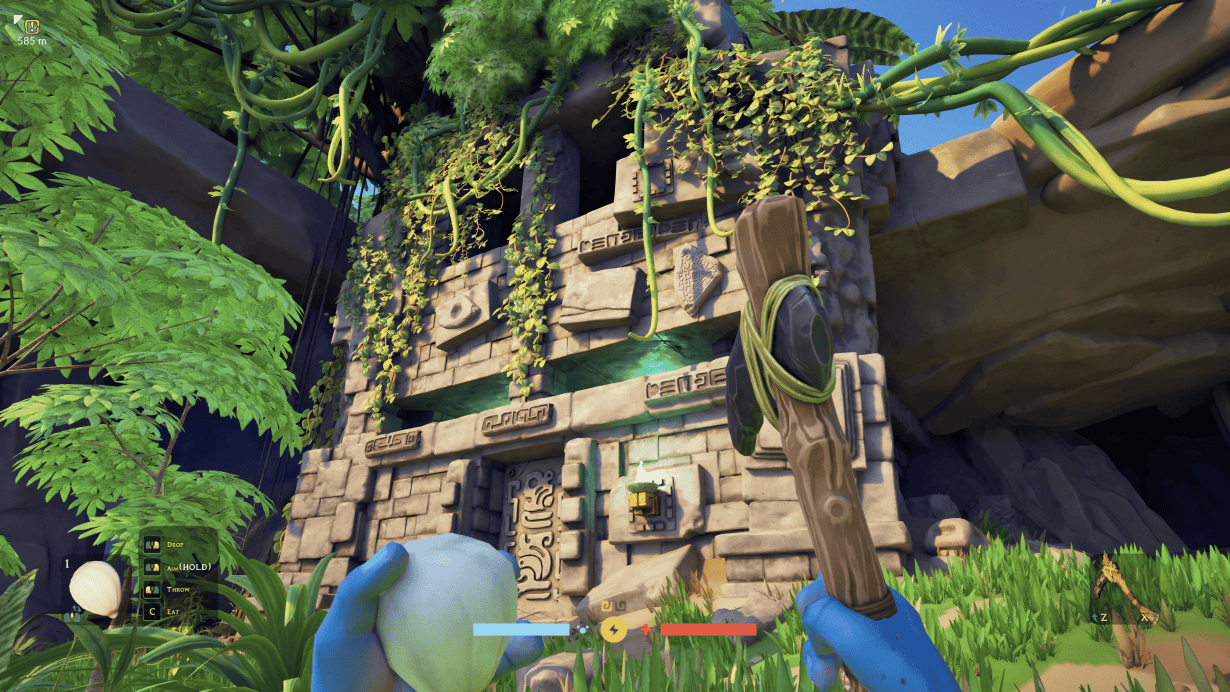
The island you explore in this Early Access build is large, lush, and genuinely fun to wander. Astrobotanica’s prehistoric Earth is colorful and inviting — far from the grim, desperate aesthetic that dominates the survival genre. Rolling hills, dense foliage, rocky coastlines, and scattered smaller islands surround the main landmass, and there’s a real sense of place to the environment that rewards curiosity. Hidden throughout the landscape are stone totems, ancient idols, and tablets containing puzzles — most involving crystal orbs that need to be pushed to specific locations to open paths or clear fog from the map. These environmental puzzles add a welcome layer of discovery beyond the core survival loop and hint at a deeper lore that the game’s full narrative campaign (planned for later in development) will presumably explore.
The Neanderthal interactions are one of Astrobotanica’s most charming features. The primal humans you encounter are curious but skittish, and building a relationship with them requires genuine effort. You’ll need to learn the basics of their language to communicate, diagnose their ailments, and craft specialized tonics to treat them. Heal a Neanderthal’s illness, and you’ll earn their trust — along with tools and building materials as gratitude. It’s a relationship system that feels organic and meaningful, reinforcing the game’s central theme: survival through cooperation and understanding, not domination. I found myself genuinely invested in these interactions, and they add a social dimension to the gameplay that most survival games completely lack.
Where the world falls slightly short in its current state is in visual fidelity. Astrobotanica is aesthetically appealing — the art direction is warm and colorful, and the creature designs are wonderfully bizarre — but texture quality can be inconsistent, particularly with ground surfaces like grass and sand that occasionally appear blurry even on high settings. Whether this is an optimization issue or a deliberate stylistic choice isn’t entirely clear, but it’s noticeable. The world is also, understandably for an Early Access launch, somewhat limited in scope compared to what the full game promises. There’s enough here for dozens of hours of thorough exploration, but the roadmap suggests significantly more islands, biomes, and systems to come.

Growing Pains: Early Access Rough Edges
Astrobotanica is in Early Access, and it’s important to be honest about what that means in practice. There are areas where the game’s unfinished state is clearly felt, and potential players should know what they’re signing up for.
The tutorial experience is a notable weak point. The game front-loads a lot of text-based instruction early on, yet somehow still leaves out critical information about certain mechanics. I found myself confused about how the double-jump works, how to deal with aggressive plant species, and what various interface symbols meant — all things that trial and error eventually resolved, but that a more thoughtful onboarding process could have clarified upfront. The map is another pain point: it currently lacks a compass or directional indicator showing where you’re facing, which makes navigation unnecessarily frustrating on an island this size. The P.R.I.M.A.L. HUD upgrade helps somewhat, but the map itself still feels underdeveloped.
Xel’s lack of voice acting is conspicuous. The character talks frequently enough through text that the absence of recorded dialogue feels like a gap rather than a deliberate choice, and it deflates some of the personality that the writing is clearly trying to convey. The developers have acknowledged this is coming, but in its current state, it creates a mild sense of disconnection from a protagonist who should be charming and relatable.
Performance optimization has improved substantially since the Steam Next Fest demo — the redesigned inventory and crafting interface are clear community-driven wins — but there are still occasional hitches. Texture loading can be slow, and some visual elements don’t render as crisply as you’d expect. None of these issues are dealbreakers, and the game’s clear 2026 roadmap (which includes plant hybridization, fishing, a campfire and cooking system, and expanded building features across three major updates) suggests that Space Goblin Studio has both the plan and the community engagement to address them systematically.

The Verdict: A Garden Worth Tending
What strikes me most about Astrobotanica is how confidently it carves its own identity. In a genre drowning in clones and variations on the same combat-harvest-build loop, Space Goblin Studio has created something that feels genuinely different. The decision to center survival around science, cultivation, and non-violent problem-solving isn’t just a marketing hook — it fundamentally changes how you think about and engage with the world. Every plant scanned, every tonic brewed, every Neanderthal healed feels like a small act of understanding rather than conquest. As Kotaku ES put it, every advance feels like a scientific discovery, not a military victory. That distinction matters, and it gives Astrobotanica an emotional texture that most survival games simply don’t have.
Is it finished? No — and it doesn’t pretend to be. The narrative campaign, co-op play, additional islands, and several major systems are still on the horizon. But the foundations are solid, the vision is clear, and the eight-person team at Space Goblin has already demonstrated a genuine commitment to building this game alongside its community. With over 100,000 wishlists before launch and a successful Kickstarter behind them, the support is clearly there. What Astrobotanica needs now is time, feedback, and continued refinement — and everything I’ve seen suggests it’s going to get exactly that.
For anyone who’s ever wished the survival genre would slow down, take a breath (of CO2, in this case), and let you think instead of fight, Astrobotanica is already a compelling experience — and it’s only going to get better from here. I walked into prehistoric Earth expecting a pleasant distraction. I walked out with dirt under my nails, a garden full of alien-compatible flora, and a genuine desire to keep exploring. That’s a very good sign.
Astrobotanica is a wonderfully original, science-driven survival game with a premise that delights and gameplay that rewards curiosity over combat, held back only by the expected rough edges of Early Access that a committed studio is actively smoothing out.