



I’ll be the first to admit that the cozy farming simulator genre has, over the past few years, become something of a minefield. For every Stardew Valley that reshapes the landscape, there are a dozen titles that coast on the genre’s warm aesthetic without doing anything meaningfully new. So when Collector’s Cove, developed by a four-person German indie team called VoodooDuck, landed in my Switch with its promise of farming on the high seas with a huggable dinosaur companion, I was cautiously curious. What I found over the next twenty-something hours was something that managed to genuinely surprise me — a game that takes a well-worn formula, drops it in the middle of the ocean, and makes it feel unexpectedly fresh.
A Tranquil Triumph — and a cozy gem that dares to think differently about the farming sim.
The Sea as Your Canvas
From the moment Collector’s Cove drops you into its character creator — where you’ll spend an embarrassing amount of time picking skin tones and hats — the game makes its intentions clear. This isn’t a race. It isn’t a survival test. It is, as VoodooDuck puts it, a tranquil journey to uncharted waters, and it commits to that identity with admirable consistency. You play as the child of legendary Named Collectors, explorers who have catalogued the rarest crops and fish the world has to offer. Left behind with your three eccentric uncles — the bumbling but lovable Jerry, the gruff and practical Terry, and the eccentric but knowledgeable Eugene — you’re tasked with following in your parents’ footsteps and earning the title of Named Collector yourself. It’s not a particularly deep narrative, and the game is honest about that. The story exists to give you a direction, not to pull you through a dramatic arc. Within the first thirty minutes, you’re casting off into open water, and the world is yours.
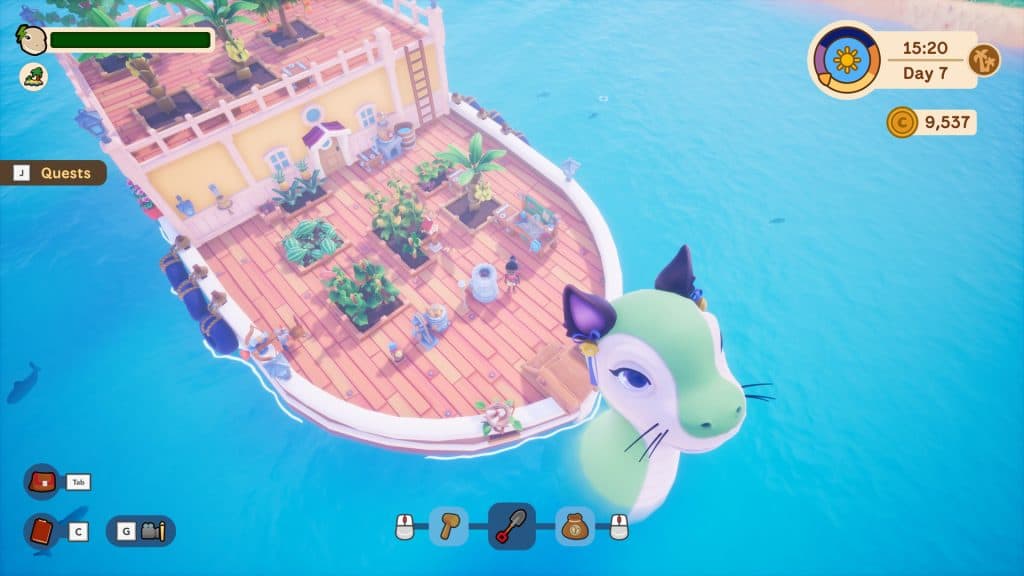
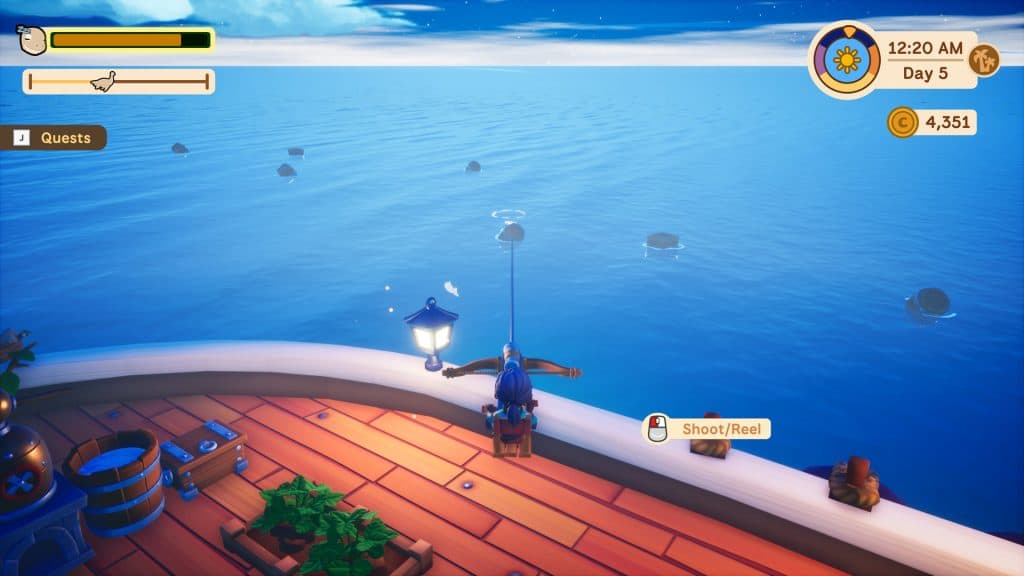
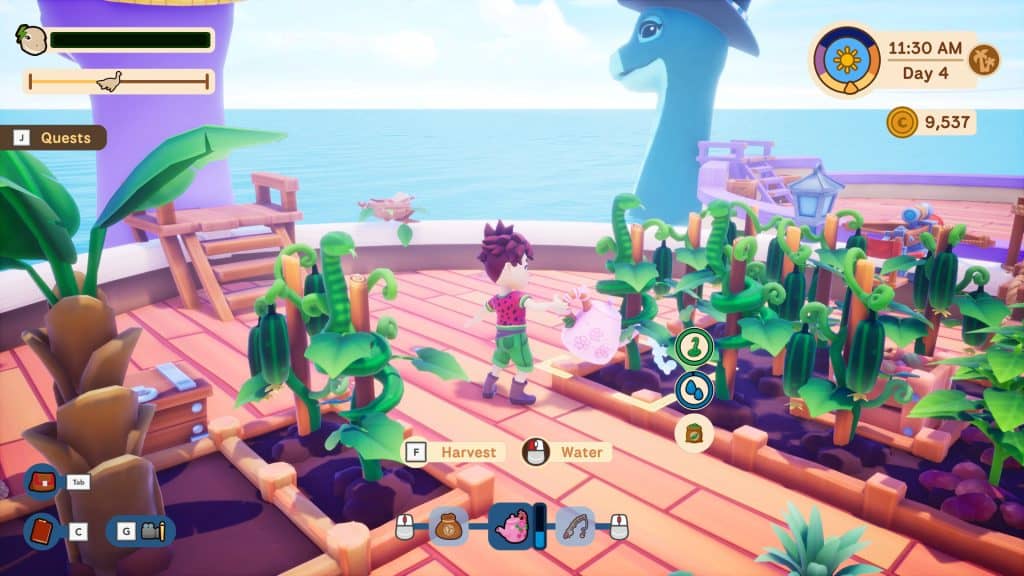
What sets Collector’s Cove apart structurally is that your farm doesn’t sit on a patch of land. It sits on the deck of your boat, which is slowly pulled across the sea by your animal companion — a gentle, Lapras-esque creature the game calls a Fablefin. Your floating farm is your home, your workshop, and your laboratory, all at once, and it travels with you as you navigate across four distinct regions, each with its own climate, flora, and aquatic life. This is the game’s most inspired design decision. In a genre where the farm is almost always a fixed anchor — a place you leave and return to — Collector’s Cove makes the farm itself a vehicle. The result is a game that feels constantly in motion, where the act of gathering and tending is never separated from the act of exploring. You’re never trudging back to base to drop off resources. You’re already there.
The four regions — starting with a breezy Tropical Trove before expanding into more challenging climates as your collector rank grows — are generated into a fresh map of eight islands each time you begin a new expedition. The island types are randomized in placement, ranging from treasure-laden outposts to resource-rich larger landmasses, and each visit involves foraging wood and stone, discovering new plant species, fishing the local waters, and occasionally stumbling across Uncle Eugene hiding behind a bush waiting to open his shop. The sense of discovery is genuine. Islands emerge from the fog as you approach them, and the small thrill of wondering what a new shore might hold never fully went away, even late in the game.
The Collector’s Compendium — A Loop Worth Chasing
At the mechanical center of Collector’s Cove sits the Collector’s Compendium, a beautifully laid-out reference book that tracks everything you’ve discovered — every crop variety, every fish species, every decoration, every piece of Fablefin attire. It is simultaneously your progression system, your to-do list, and your most satisfying source of small victories. Time pauses when you open it, which is a small but thoughtful quality-of-life decision that means the compendium never feels like a penalty. Instead, browsing it mid-voyage becomes a genuinely pleasurable ritual — flicking through pages to see how many pineapples you need to unlock their special fertilizer, or checking the fabled conditions for a particular fish.
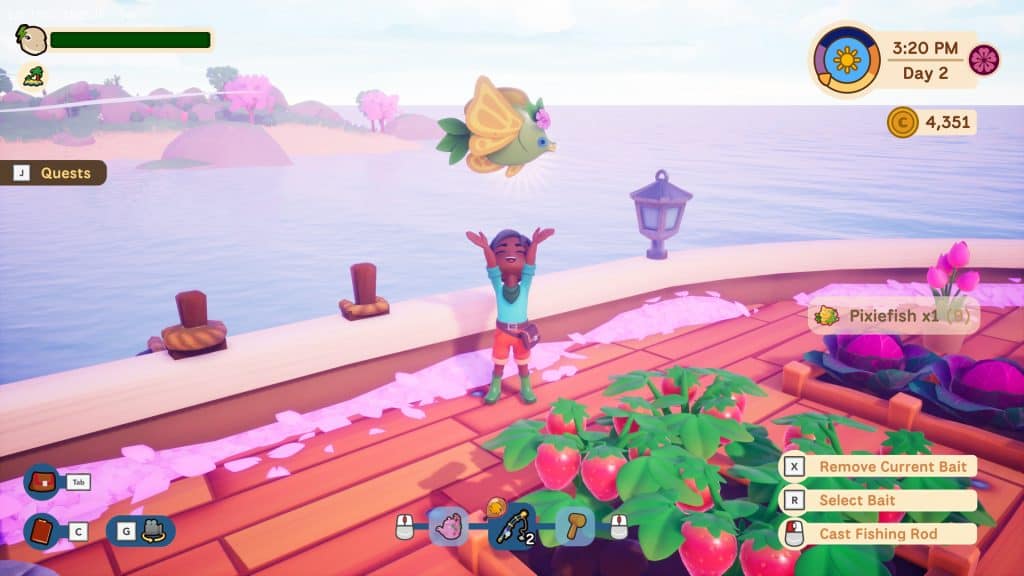
The fabled system is where the game earns its “Collector” title. Each crop and each fish has a standard version, a quality version, and a fabled variant — a fantastical, renamed form of the species that sells for significantly more and can be gifted to your Fablefin to strengthen your bond. Unlocking the path to a fabled item requires patience: first, you must grow or catch enough of the standard item to unlock a special fertilizer or bait recipe. Then, you must meet a specific condition — sometimes quirky, sometimes logistical — to trigger the fabled variant. One fish, I discovered, required my Fablefin to be wearing at least two different accessories simultaneously. These conditions are cheeky and inventive, and discovering them is one of the game’s most reliable sources of delight.
Progression through the Compendium also unlocks new crafting recipes and regions. Working toward high-tier upgrades — among them an extended crop hydration system that waters your plants even as you sail, and an auto-fisher that reels in catches while you tend to other tasks — provides a tangible, earned sense of growth. These aren’t just cosmetic rewards. They meaningfully change how you interact with the world. When the auto-fisher finally came online, it genuinely transformed my late-game rhythm, giving me space to focus on fabled conditions while the system handled the routine. That sense of earned mechanical evolution is something the best farming sims do well, and Collector’s Cove does it convincingly.
Crafting itself benefits from a decision that I hope becomes standard in the genre: you can build and craft directly from your storage inventory. In an era where too many games still require you to physically hold materials in your active slots before allowing you to work with them, this is a quiet revolution. It keeps the experience frictionless and contributes to that flow state where you lose track of real-world time without quite noticing.
Your Fablefin: The Heart of the Journey
I wasn’t prepared to care as much as I did about the Fablefin. I went into Collector’s Cove expecting a mechanical companion, a boat engine with a face. What I got was something that, by the end of my playthrough, I was checking on between tasks and customizing with hats out of what can only be described as affection. The Fablefin is the game’s emotional core, and VoodooDuck, to their credit, understood that clearly. You can customize her color scheme, markings, and eye shape from the start, and as you discover accessories across the world, you can dress her in glasses, hats, and facial attire that range from dignified to absurd. You can hug her. This is not a small thing.
Beyond the emotional register, the Fablefin is also the game’s most interesting resource to manage. She has a stamina gauge that depletes as she pulls your vessel between islands, and when depleted she needs rest — which you can accelerate by feeding her. This isn’t punishing; it’s paced. The rest periods become natural beats in the session rhythm, moments where you turn your attention to the boat itself — decorating the cabin, sorting storage, tending crops that don’t require you to be actively present. These pauses feel designed rather than incidental, and they prevent the exploration loop from ever feeling truly monotonous. As you progress and your bond with the Fablefin grows, her stamina increases and new interactions unlock, which adds a genuine sense of relationship-building to what could have been a purely mechanical system.
The bond mechanic — deepened by gifting your Fablefin one of each fabled item — is quietly one of the most clever design choices in the game. It ties the game’s most demanding completionist content (finding every fabled variant) directly to the emotional throughline (caring for your companion), creating a natural motivation to engage with the harder grind. You’re not farming rare crops because a checklist told you to. You’re farming them because you want to see what the next interaction with your Fablefin unlocks. That’s good design, and from a four-person team, it’s genuinely impressive.
Crafting, Customization, and the Ship as Home
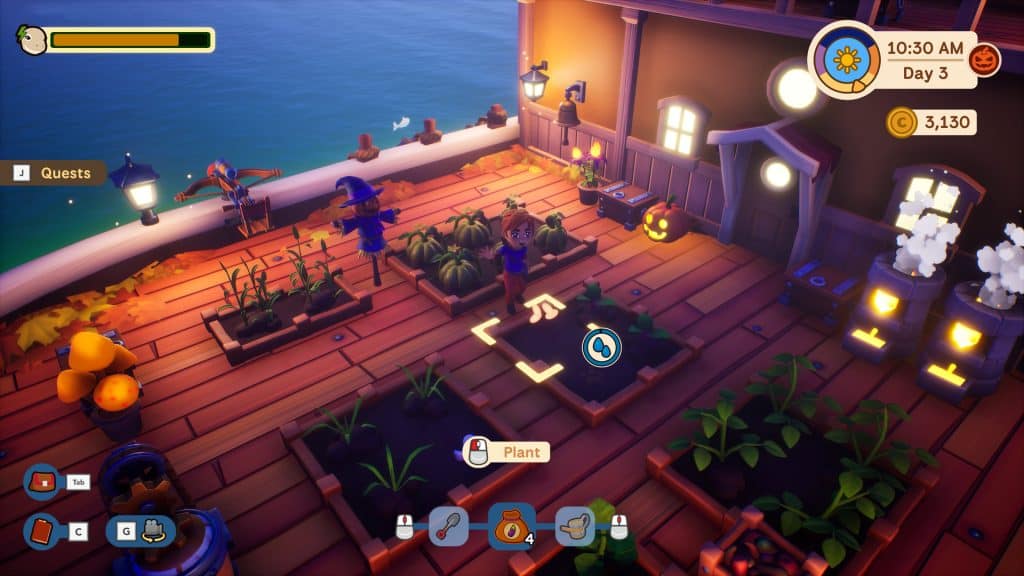
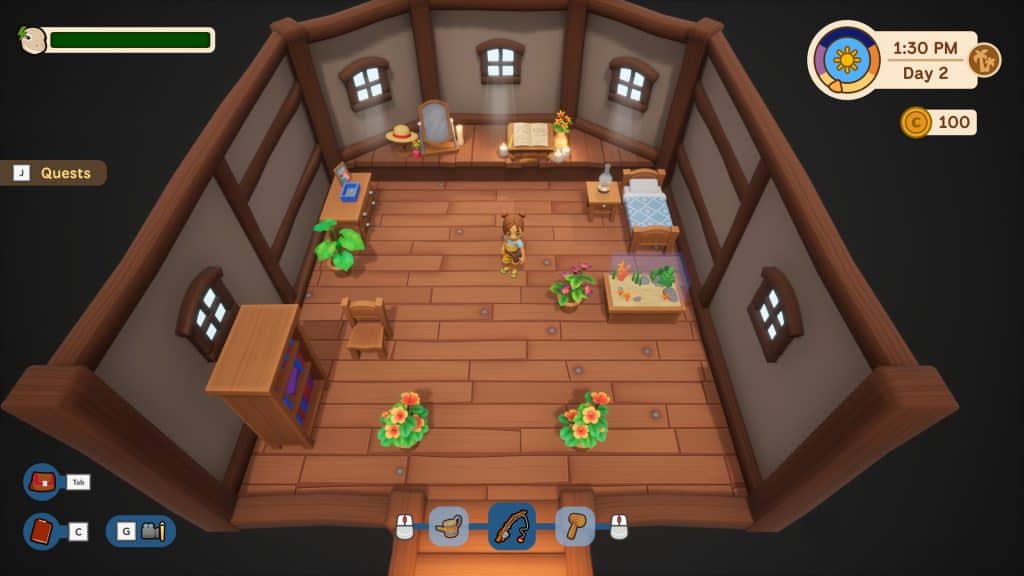
The boat in Collector’s Cove is more than a vehicle. It is, progressively, a home — and one of the game’s most satisfying long-term investments. You can upgrade the vessel twice over the course of the game, expanding both the outdoor deck space available for crops and the indoor cabin area for furniture and decoration. The crafting system, which draws on foraged wood and stone alongside traded materials, ties neatly into the broader progression structure; the more you explore and sell, the more resources you accumulate for the next tier of expansion. By the later stages of the game, my floating farm had taken on a personality entirely its own — butterfly houses on the upper deck, a fully expanded cabin below, and my Fablefin wearing a large novelty hat.
The customization system is genuinely enjoyable, though it is one of the areas where the game’s scope begins to show its seams. There are roughly a dozen furniture pieces available per region, which means that while the system is perfectly functional, committed decorators may find the well running dry before the endgame. It lacks the staggering depth of customization seen in, say, Animal Crossing: New Horizons, though the comparison is perhaps unfair to a four-person studio working at a fraction of the budget. What’s here is charming and serves the experience well; I simply wanted more of it, which is ultimately a compliment to how enjoyable the system is when it works.
The three uncles — Jerry, Terry, and Eugene — serve as the game’s primary NPCs, and their presence is warm if limited. Each manages a shop aboard Uncle Jerry’s boat, selling seeds, trading resources, and exchanging crops for recipes and decorations. The rotating nature of their appearances, and the mildly comedic business of all three running between their respective shops when you summon them, is amusing in a low-key way. They serve their purpose. Do not come to Collector’s Cove expecting a cast of memorable characters or meaningful dialogue arcs; these are functional personalities, not fully fleshed ones, and the game wears that limitation honestly.
Performance, Polish, and a Few Rough Waves
On Nintendo Switch, Collector’s Cove runs with commendable stability both in docked and handheld modes. The text is large enough to read comfortably on a Switch Lite screen, touchscreen input is supported, and the autosave system — which also triggers at sleep points and at the main menu — is unobtrusive and reliable. For a game built by a team of four, the overall technical foundation is solid. The controls are well-explained and persistently displayed on screen, with full button remapping available in the settings. These are not glamorous features, but they reflect a team that understands how this genre is actually played, often in short bursts on a handheld at odd hours, and has built accordingly.
That said, the game is not without its rough edges. The most persistent issue I encountered was the presence of invisible collision walls on islands, sections where my character would suddenly grind to a stop for no visible reason before the obstacle inexplicably disappeared. In a game built on the premise of relaxed exploration, these jarring interruptions break the flow in ways that feel disproportionately annoying. They were never game-breaking, but they were consistently present. There are also a handful of minor visual bugs in the pre-launch build — a wrong picture attached to a particular fabled crop, quality variants failing to display their star icon on capture — which are the kind of cosmetic issues a day-one patch typically addresses, but which are worth noting.
The audiovisual presentation is pleasant but safe. The pastel art style is clean and cohesive, with a warmth that suits the game’s tone perfectly. It occasionally reads as slightly washed-out on brighter screens, and outdoor handheld play in direct sunlight will make the later Haunted Harbours region genuinely hard to parse — a brightness setting exists and helps, but the palette choice does limit visibility in certain conditions. The soundtrack, meanwhile, provides exactly the kind of gentle, looping ambience the genre demands, and it does its job without ever distinguishing itself. It supports the experience competently and fades into the background in a way that may be a feature or a flaw depending on your expectations. I found myself layering my own playlist over it after the first few sessions, which speaks to something.
A Voyage Worth Taking
Collector’s Cove is not without flaws, and I think it’s important to be clear-eyed about what it is. It is not a sprawling life sim with hundreds of hours of content. It is not trying to be Stardew Valley or Animal Crossing, even if it shares a neighborhood with both. What it is, more precisely, is a focused, confident, and thoughtfully designed small-scope experience that does several things exceptionally well and a few things only adequately. The roughly 28 hours it takes to reach the Named Collector rank and complete the compendium feels like the right size for the ideas it contains — not padded, not truncated, but calibrated. The moment the credits rolled, I felt satisfied rather than shortchanged, and that is not a given in a genre where scope often masquerades as value.
The things it gets right are worth celebrating: a genuinely novel setting for the farming sim formula, a companion system with real emotional resonance, a progression mechanic that gives every grind a clear purpose and satisfying payoff, and quality-of-life choices that reflect a team that has played deeply in this genre. VoodooDuck, four people working in tandem, have created something with a coherent identity and enough craft behind it to justify every cent of it’s price tag. In a market crowded with cozy-branded titles that fail to deliver on that promise, Collector’s Cove is the genuine article.

If you are looking for your next meditative portable adventure — the kind of game you play for an hour before bed, lose track of time, and put down reluctantly — this is an easy recommendation. Its rough edges are real but minor. Its strengths are genuine and, in the case of the Fablefin, quietly remarkable. It does not reinvent the genre, but it finds a new corner of it, and it inhabits that corner with enough warmth and mechanical intelligence to stand on its own. Set sail.
Collector’s Cove earns its berth as one of the most inventive cozy releases of 2026: a small studio’s big heart, afloat on the open sea.