



MIO: Memories in Orbit is as challenging as it is enchanting, and I loved every minute of it.
After spending the past week immersed in MIO: Memories in Orbit on my Nintendo Switch 2, I’m happy to report that this indie Metroidvania has captivated me like few games have. From the very first moments, I was drawn in by a beautiful, decaying sci-fi world and a mesmerizing art style that feels at once nostalgic and futuristic. Playing as MIO – a small, nimble robot awakened aboard a massive derelict spaceship called The Vessel – I ventured through overgrown techno-organic ruins in search of answers. The game’s story unfolds gradually: The Vessel’s AI caretakers (known as Pearls) have mysteriously gone silent, and it’s up to MIO to revive lost memories and prevent the ship’s imminent shutdown. This narrative setup provides a haunting backdrop to the adventure. While the storytelling is subtle and leaves some mysteries hanging, it gives just enough motivation to keep pushing forward. And push forward I did – because MIO: Memories in Orbit is as challenging as it is enchanting, and I loved every minute of it.

Gameplay and Exploration
At its core, MIO: Memories in Orbit nails what makes the Metroidvania genre great. The gameplay is fluid, precise, and immensely rewarding for those who persevere. MIO starts with basic movement and a simple orb attack, but as I explored the Vessel’s labyrinthine corridors I steadily unlocked extraordinary abilities that completely opened up the game’s traversal. Before long I was scaling walls like a spider, swinging across chasms with a grappling hook, and gliding through the air with mechanical wings. Each new power not only made me feel more agile, but also unlocked previously unreachable areas in classic Metroidvania fashion. The level design is brilliantly interconnected – The Vessel is essentially one gigantic, intertwined maze full of hidden passages and secret rooms. Backtracking with new abilities to discover tucked-away upgrades became one of my favorite parts of the loop. There were moments I got a bit lost in the sprawling map or had to retread familiar ground searching for the next step, but that’s part of the appeal here. The sense of exploration and discovery is strong, and when I finally cracked a tough navigation puzzle or found a cleverly concealed shortcut, it felt genuinely triumphant.

Crucially, the controls on Switch 2 are tight and responsive, which they need to be given the precision required. Jumps, dashes, and swings all feel satisfyingly snappy. The developers clearly designed MIO’s movement to encourage creative play – for example, I learned that landing a hit on an enemy mid-air resets your double-jump, allowing skilled players to chain attacks and jumps in exhilarating ways. There’s even a technique where stomping downward on foes or objects lets you bounce to gain extra height, a trick that became essential in some platforming sections. Combat itself is straightforward to learn but difficult to master. MIO can attack in multiple directions and later gains an arsenal of special powers (like deploying decoy clones or firing energy orbs) which you’ll need to strategically employ. I appreciated that the game lets you customize MIO’s loadout and attributes to suit your playstyle by finding upgrade components. By the end of my playthrough, my MIO was tailored with a set of modifiers that, for instance, traded a bit of attack power for an extra chunk of health – a trade-off I was happy with. This light RPG-style tuning adds depth to the gameplay without ever becoming overwhelming. Overall, the mix of precise platforming, combat, and exploration kept me on my toes and completely absorbed for the 30+ hours it took to reach the credits.

World and Art Direction
This game is gorgeous.
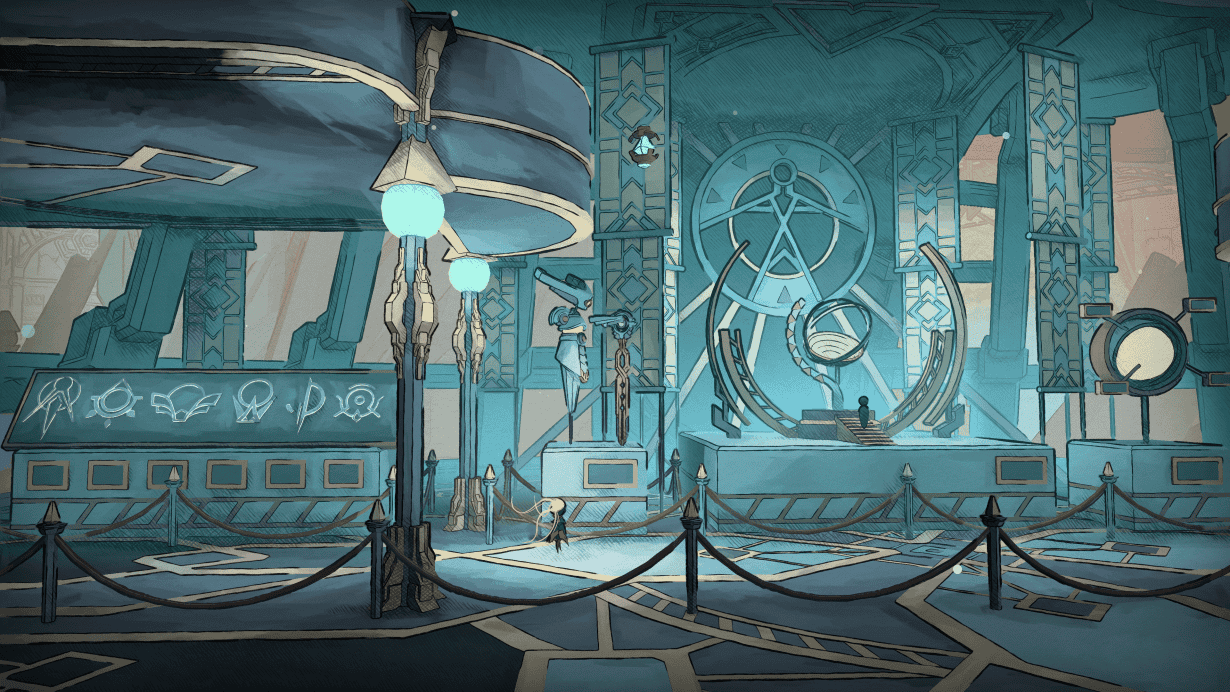
If the gameplay is what hooked me, the art and world of MIO are what made me never want to leave. This game is gorgeous. Every inch of The Vessel is rendered in a fully hand-drawn art style that melds science fiction with a painterly touch. The environments often stopped me in my tracks: one moment I’d be in a dimly lit engine bay overrun with twisting vines and bioluminescent fungi, and the next I’d emerge into a shattered observatory with cosmic nebulae visible through the cracked hull. The art direction takes inspiration from classic animation and art. There’s a touch of Studio Ghibli’s whimsical detail and heart in the lush overgrowth, and hints of storybook watercolor style (I was even reminded of the animated film Ernest & Célestine in some of the softer background palettes). Despite the ruin and decay of the spaceship setting, there’s a gentle beauty to how it’s portrayed – a mix of melancholy and wonder that permeates every locale. Each region of The Vessel has its own distinct visual theme and color palette, keeping exploration feeling fresh. From eerie, neon-lit machine factories to serene botanical gardens sprouting from the ship’s rusted interior, the game constantly delivers new eye candy. The fact that all of this was created by a small team of artists is astounding; the level of detail and cohesion in the world-building rivaled that of much larger productions.

The atmosphere is further enhanced by excellent sound design and music. MIO: Memories in Orbit features a subtle, haunting soundtrack that perfectly suits its lonely sci-fi mood. While playing, I often noticed gentle ambient melodies underscoring my exploration, occasionally accented by ethereal choral harmonies that gave me goosebumps during pivotal moments. The audio knows when to stay quiet and when to swell, making the few story climaxes and boss encounters feel that much more epic. Environmental sound is on point as well – creaking metal in the background, distant echoes in cavernous chambers, the hum of ancient machinery waking up as you restore power. Together, the art and audio create an immersive backdrop that pulled me deep into The Vessel’s universe. There were times I simply stood still on a high ledge, admiring a distant vista of the ship’s architecture entwined with giant tree roots, all while a faint piano tune played. It’s in these moments that MIO: Memories in Orbit achieves a rare poetry in its presentation. The world tells its story through imagery as much as through text or dialogue, and I found myself genuinely intrigued by the fragments of lore and history I uncovered. Admittedly, the narrative is quite minimalistic – you won’t get lengthy cutscenes or explicit explanations of everything that happened before. But in a way, that mystery is part of the charm. The game trusts you to piece together its story through exploring memory shrines, scanning log terminals, and observing the environment. This subtle storytelling might not satisfy those looking for a character-driven plot, yet it gave me the freedom to interpret the whys and hows of The Vessel’s fate on my own. Personally, I found the sense of loneliness and lost history very moving by the end.

Challenge and Difficulty
Let’s talk about the elephant in the room: MIO is hard. This game does not go easy on the player – it’s clearly designed to push your skills to the limit, much like the genre greats it draws inspiration from. As a seasoned Metroidvania fan, I relished the steep challenge, but I’d be lying if I said I never felt frustrated. Expect intense platforming sequences that demand perfect timing and boss fights that will kill you dozens of times until you master their patterns. Even early on, a seemingly simple task like reaching a new area can involve a gauntlet of spikes, moving platforms, and enemy gauntlets that had my palms sweating. The boss encounters, in particular, are ferocious highlights: each of the major guardians you face has a distinct attack pattern and often multiple phases. I can recall one mid-game boss – a colossal, corrupted AI core – that took me nearly two evenings of attempts to finally beat. When I at last dealt the final blow, I actually whooped out loud in pure adrenaline and relief. These victories are hard-earned and immensely satisfying, which is exactly what I crave from games like this. However, I also recognize not everyone will enjoy the level of punishment on offer. MIO: Memories in Orbit sometimes crosses the line from challenging into outright punishing. Checkpoints can be spread out far apart, meaning a mistake might send you back a good distance. Additionally, the game doesn’t always point you clearly toward the next objective – more than once I cleared a tough section only to be unsure where to go next, wandering until I realized I needed to use a newly acquired upgrade in a previously visited area. For me, figuring that out was part of the fun, but less patient players might find the lack of guidance and frequent backtracking a bit tedious.

One aspect I truly appreciate is that the developers included flexible difficulty assists for those who need them. Tucked away in the settings is an “Assists” menu offering optional modifiers that can significantly ease the challenge. For example, there’s an “Eroded Bosses” feature which will slightly reduce a boss’s max health each time you die to it, giving you a better chance after repeated failures. There’s even a “Pacifist Mode” that envelopes MIO in a protective aura, causing regular enemies to ignore you entirely until you choose to strike them (though bosses will still happily try to crush you). Another assist can grant a temporary shield if you stay grounded and still for a few seconds – a godsend if you’re struggling to survive a tricky section with low health. These options show a commendable commitment to accessibility; MIO wants hardcore players to have their brutal experience, but also wants less experienced players to be able to see the journey through. In my case, I’ll admit I’m stubborn – I left all assists off for my first run to experience the game as intended. But it’s wonderful that these tweaks are available. In fact, I tested them briefly after finishing, and they work seamlessly to soften the game’s edges without completely nullifying the challenge. Even with assists, you still need to play well; they just provide a bit of extra breathing room. I encourage anyone who loves the look and idea of this game but fears the difficulty to make use of these tools. There’s no shame in tailoring the experience to your taste. The core design remains tough-but-fair in my view, and knowing there was a safety net if I ever got truly stuck made the toughest moments less discouraging.

I should also note how MIO: Memories in Orbit handles failure and progression, since it ties into the challenge. When you die (and you will), you typically respawn at the last save point or checkpoint you used. The game has a currency system – a sort of glowing resource called Nacre – that you collect from defeated enemies and hidden caches. If you fall in battle, you’ll drop your accumulated Nacre, much like souls in certain other games. However, MIO has the ability to “solidify” or bank this currency at special stations scattered around the map, protecting it from loss. This mechanic added a tense risk-reward element: do I push a little farther with a ton of unspent Nacre hoping to find the next save point, or backtrack to secure it? On a couple of occasions I got overconfident, didn’t bank my stash, and paid the price by losing a hefty chunk of currency on death. Thankfully, this loss isn’t permanent – you can usually retrieve dropped Nacre if you return to where you died – but doing so means surviving the trek back. It’s an exhilarating (and sometimes nerve-wracking) cycle that further emphasizes the game’s challenging nature. Between tough enemies, punishing platforming, and these survival mechanics, MIO consistently kept me engaged and on edge. Yet for all the trial and error, I never felt cheated. The challenges are meticulously designed and can be overcome with skill and a bit of planning. I rarely felt that the game was unfair; instead, it expects you to learn from mistakes and improve, which made my eventual successes all the sweeter.

So, is it worth it?
In the end, MIO: Memories in Orbit swept me away with its visual splendor, intricate world, and demanding gameplay. It’s a passionate, uncompromising vision of a Metroidvania that pays homage to the classics of the genre while crafting its own identity through art and atmosphere. I came away from The Vessel’s depths feeling equal parts exhausted and exhilarated. This is not a journey that holds your hand – it’s one that challenges you to earn every inch of progress, and then rewards you with breathtaking vistas and the satisfaction of overcoming the impossible.

It won’t be for everyone; casual players or those who shy away from high difficulty might find MIO’s relentless trials daunting. But if you, like me, enjoy a game that truly tests your mettle and then dazzles you at every turn, MIO is an unforgettable adventure. I can easily see myself reminiscing about certain beautiful scenes or harrowing boss battles for a long time to come. For all its occasional rough edges in pacing or difficulty spikes, the overall experience is one of cohesive brilliance – a game that challenged me, inspired me, and reminded me why I love this genre. I give MIO: Memories in Orbit a score of 4.6 out of 5 stars, and I highly recommend it to any player ready to brave a stunning world that doesn’t want to let you go.
Disclosure: I was given a complimentary review key to facilitate this review. Receiving it did not impact my assessment.
★★★★✬
🇵🇹 Análise a 'MIO: Memories in Orbit' – Um desafio hipnotizante

Depois de passar a última semana mergulhado em MIO: Memories in Orbit na minha Nintendo Switch 2, posso dizer com confiança: este Metroidvania indie capturou-me como poucos jogos conseguem. Desde os primeiros minutos, fui puxado para um mundo sci-fi decadente e para um estilo artístico hipnotizante, simultaneamente nostálgico e futurista. No papel de MIO — um pequeno e ágil robô que desperta a bordo de uma nave colossal e abandonada chamada The Vessel — explorei ruínas tecnológicas engolidas pela vegetação à procura de respostas. A premissa é simples e eficaz: os “Pearls”, os cuidadores de IA da nave, deixaram de funcionar sem explicação, e cabe a MIO reactivar memórias perdidas e evitar a destruição iminente da nave. É uma base narrativa discreta, mas suficientemente forte para justificar a descida constante às profundezas. E eu desci, vezes sem conta — porque MIO: Memories in Orbit é tão difícil quanto deslumbrante, e eu adorei cada segundo.

Jogabilidade e exploração

No essencial, MIO: Memories in Orbit acerta em cheio no que torna o género Metroidvania tão viciante. A jogabilidade é fluida, precisa e extremamente recompensadora para quem insiste. MIO começa com mobilidade básica e um ataque simples, mas, à medida que fui explorando os corredores labirínticos de The Vessel, desbloqueei capacidades que transformam por completo a forma como nos movemos pelo mundo. Em pouco tempo, estava a escalar paredes, a baloiçar com um gancho (grappling hook) e a planar no ar, abrindo rotas que antes pareciam impossíveis. Cada nova habilidade não só reforça a sensação de agilidade, como desbloqueia zonas antigas de forma clássica e satisfatória.

O design do mapa é brilhantemente interligado — The Vessel funciona como um gigantesco organismo, um emaranhado de passagens, atalhos e salas secretas. Voltar a áreas anteriores com novas capacidades para descobrir melhorias escondidas tornou-se uma das minhas rotinas favoritas. Houve momentos em que me senti um pouco perdido, ou em que precisei de refazer caminhos à procura do próximo passo, mas faz parte da identidade do jogo. A sensação de descoberta é constante e, quando finalmente encontrei um atalho bem escondido ou resolvi um “bloqueio” de progressão, o sentimento de vitória foi real.

Ainda mais importante: os controlos na Switch 2 são firmes e responsivos, como têm de ser num jogo tão exigente. Saltos, esquivas e balanços respondem com precisão, e o jogo incentiva uma abordagem criativa ao movimento. Um exemplo: aprendi rapidamente que atingir um inimigo no ar pode repor o duplo salto, permitindo encadear ataques e saltos com uma fluidez quase acrobática. Também há situações em que ataques descendentes ajudam a ganhar altura e a prolongar sequências de plataforma — detalhes que acabam por ser essenciais nos momentos mais exigentes.

O combate é fácil de entender, mas difícil de dominar. MIO ataca em várias direcções e, mais tarde, ganha ferramentas adicionais — projécteis, habilidades especiais e opções tácticas — que fazem a diferença quando o jogo deixa de ter qualquer complacência. Gostei particularmente do modo como podemos ajustar o estilo de jogo com modificadores e melhorias: no final, tinha uma configuração que trocava um pouco de dano por mais resistência, e senti que fazia sentido para a forma como eu estava a abordar os confrontos. É um sistema simples, mas com profundidade suficiente para dar identidade à progressão sem a tornar pesada.

Mundo e direcção artística

Se a jogabilidade me agarrou, foi a direcção artística e o mundo que me fizeram não querer sair. Este jogo é, pura e simplesmente, lindíssimo. Tudo é desenhado com uma estética totalmente artesanal, que mistura ficção científica com uma sensibilidade quase pictórica. Houve cenários que me obrigaram a parar: num momento estava numa secção industrial escura, de metal gasto e tubos expostos, no seguinte surgia numa estrutura aberta, com luz a atravessar vitrais e vegetação a invadir corredores como se a natureza tivesse “reclamado” a nave.

Apesar do tom de decadência, existe uma beleza suave e melancólica em cada zona — uma mistura de ruína e poesia que dá ao jogo uma personalidade própria. Cada região tem identidade visual e paleta de cores distintas, mantendo a exploração sempre fresca. E o mais impressionante é a consistência: o mundo parece pensado e pintado como um todo, com detalhe e coerência raros num projecto indie.

A atmosfera ganha ainda mais força com o som e a música. A banda sonora é contida, etérea quando precisa e silenciosa quando o jogo quer que sintamos a solidão. O design sonoro também ajuda a dar vida a The Vessel: o ranger do metal ao longe, o zumbido de maquinaria antiga, ecos em câmaras enormes. Houve momentos em que fiquei parado num patamar, só a observar um cenário distante, com uma melodia subtil ao fundo. É nesses instantes que MIO atinge algo especial — uma sensação de contemplação que contrasta com a intensidade do combate.

Narrativamente, o jogo opta por uma abordagem minimalista. Não há grande exposição nem longas cenas explicativas — o enredo é sugerido através do mundo, de fragmentos de informação e da própria descoberta de memórias. Isso pode não satisfazer quem procura uma história mais directa e guiada, mas eu apreciei a confiança do jogo em deixar espaço para interpretação. No final, saí com a sensação de ter atravessado um lugar com passado, com cicatrizes e com mistérios suficientes para permanecerem na cabeça.

Desafio e dificuldade

Vamos ao ponto que define MIO: Memories in Orbit: este jogo é duro. Muito duro. É um Metroidvania construído para testar capacidade, reflexos e persistência. Eu adorei isso, mas também seria desonesto se dissesse que nunca senti frustração. Há secções de plataformas que exigem timing perfeito e bosses que me obrigaram a repetir tentativas até memorizar padrões e encontrar o ritmo certo. Alguns confrontos são verdadeiros muros — e é precisamente por isso que a vitória sabe tão bem.

Ao mesmo tempo, reconheço que nem toda a gente vai querer este nível de exigência. Há alturas em que o jogo se aproxima do punitivo: alguns checkpoints ficam afastados e certos picos de dificuldade podem ser bruscos. Além disso, MIO nem sempre indica claramente o próximo passo, e a exploração implica atenção e curiosidade — por vezes, tive de revisitar zonas anteriores para perceber onde uma nova habilidade se encaixava. Para mim, isso faz parte do fascínio. Para outros, pode traduzir-se em desgaste.

Felizmente, existe um conjunto de opções de assistência que permite ajustar a experiência. Sem transformar o jogo numa “viagem automática”, estas opções ajudam quem precisa: há um sistema que reduz gradualmente a vida máxima dos bosses após falhas repetidas, um modo que faz com que inimigos comuns não ataquem até serem provocados, e até uma assistência que concede protecção temporária se ficarmos parados no chão durante alguns segundos. Eu joguei a maior parte do tempo sem recorrer a estas ajudas — por teimosia e por querer sentir o desafio “como foi desenhado” — mas valorizo muito a existência destas ferramentas. É um sinal claro de que o jogo quer ser exigente sem ser excluinte.

Também gostei do modo como o jogo lida com risco e progressão. Existe uma moeda/recurso que acumulamos e que pode ser perdido temporariamente com a morte, incentivando decisões do tipo: avanço mais um pouco e arrisco, ou recuo para “guardar” o que tenho? Este ciclo de tensão e recompensa encaixa perfeitamente no tom do jogo e faz com que cada passo conte — e, acima de tudo, mantém-nos emocionalmente investidos.

Vale a pena?

No final, MIO: Memories in Orbit conquistou-me pela combinação de arte deslumbrante, mundo interligado e exigência sem compromissos. É um Metroidvania com identidade própria, que presta homenagem aos clássicos do género sem perder a sua voz. Saí de The Vessel exausto, sim — mas também genuinamente entusiasmado. Este não é um jogo que nos dá vitórias fáceis. É um jogo que nos obriga a merecê-las e, quando as conquista, retribui com cenários memoráveis e uma sensação de superação que poucos títulos conseguem.

Não é para todos: quem procura uma experiência relaxada pode estranhar a dureza e a falta de orientação directa. Mas se, como eu, gosta de jogos que desafiam a sério e que, ao mesmo tempo, conseguem ser belos e hipnotizantes, então MIO é uma viagem altamente recomendada.