


Prime Video | 8 Episodes | Premieres March 4, 2026
I’ll admit it: I walked into Young Sherlock with cautious optimism and walked out genuinely exhilarated. There’s something almost reckless about what Guy Ritchie, showrunner Matthew Parkhill, and a stacked ensemble have dared to do here — strip the world’s most iconic detective down to his rawest, most volatile self and make us fall in love with him all over again. This is not the polished, pipe-smoking mastermind of Baker Street legend. This is a 19-year-old Sherlock Holmes who is a mess — brilliant, combustible, and utterly gripping to watch. And it works magnificently. Young Sherlock is one of the most daring, ambitious origin stories I’ve seen in years: a series that weaves its clues, mysteries, and solutions with the kind of crazy-smart, intricate craftsmanship that makes you rewind scenes just to catch what you missed the first time. This is the Sherlock Holmes show we didn’t know we needed.
A brilliant reimagination of a beloved icon — daring, smart, and relentlessly entertaining.

The Origin Story We Actually Deserved
At its heart, Young Sherlock is deceptively simple in its premise and gloriously complex in its execution. When a murder at Oxford University puts the disgraced, unruly Holmes squarely in the crosshairs of suspicion, what begins as a campus mystery almost immediately spirals into something far larger — a globe-trotting conspiracy that pulls him across Victorian England and beyond, and that will fundamentally alter the course of his life.
What sets this series apart from the crowded field of Sherlock adaptations — Benedict Cumberbatch’s Sherlock, the Robert Downey Jr. films, Elementary, Enola Holmes — is that it refuses to take the easy road. Rather than anchoring Holmes to Watson as his emotional crutch and moral compass, Young Sherlock does something far more interesting: it grounds him in family. The push-and-pull with his father Silas Holmes (Joseph Fiennes), the quiet gravity of his mother Cordelia (Natascha McElhone), the brotherly rivalry with Mycroft (Max Irons) — these relationships give the show an emotional backbone that feels fresh and genuinely earned.

And then there is Moriarty. Played by Dónal Finn with a chilling, magnetic intelligence, the future nemesis is not saved for a season finale tease. He is here, from the beginning, entwined in Sherlock’s first case — and the decision to cast them as former friends rather than simply enemies is the series’ most inspired creative choice. That history makes every shared scene feel loaded with a tension that a simple rivalry never could. As Fiennes Tiffin himself has noted, it enriches the eventual antagonism in ways that feel both deeply human and dramatically devastating. Watching two extraordinarily gifted young men on a collision course with destiny, knowing how it ends, is quietly heartbreaking.
The writing trusts its audience completely. The clues are interlocked with a precision that rewards attention — a detail mentioned in episode two pays off in episode six, a seemingly throwaway exchange plants the seed of a revelation that reframes everything before it. It’s the kind of storytelling that demands and deserves a proper binge, where the full architecture of the mystery can be appreciated as a whole.

The Ritchie Fingerprint — In the Best Possible Way
If you have spent any time with Guy Ritchie’s cinematic universe — from Lock, Stock to the Sherlock Holmes films to The Gentlemen — you will recognize his touch instantly here. The kineticism. The wit buried in the chaos. The world that feels just a few degrees heightened from reality, operating by its own internal logic and doing so with tremendous confidence. Young Sherlock carries all of that DNA and then adds something more: genuine emotional grit.
This is not a show that confuses style with substance. Yes, the action sequences are slick and propulsive; yes, the production design of 1870s Oxford is gorgeous and immersive, with Victorian England rendered with both grandeur and grime. But the style always serves the story. The action exists to reveal character — every confrontation tells us something about who Sherlock is, what he fears, what he cannot yet control. Ritchie, who directs the opening episodes and executive produces throughout, does not let the spectacle eclipse the humanity underneath it.
And the series is smartly, sharply funny. This is not broad comedy but the kind of wit that lives in character — in the gap between how Sherlock sees himself and how the world sees him, in the absurdity of watching a genius repeatedly undone by his own arrogance, in the interplay between characters who are each operating on different frequencies. The humor lands because it never undercuts the drama; it simply makes it more human. This tonal balance — thrilling and warm, sharp and emotionally serious — is extraordinarily difficult to achieve, and Young Sherlock pulls it off with apparent ease.

A Cast That Elevates Everything
Hero Fiennes Tiffin is, put simply, a revelation. I was aware of the expectation-management challenge facing any actor stepping into Sherlock Holmes — one of the most interpreted characters in literary history — and I was prepared to be impressed while feeling the seams. I was not prepared to forget entirely that I was watching an interpretation. Fiennes Tiffin makes this Sherlock completely, unmistakably his own.
He plays the character’s genius not as cool detachment but as a kind of barely contained overwhelm — a mind that moves faster than its host can manage, producing not calm authority but combustible energy that borders on self-destruction. He is funny, yes, but also genuinely vulnerable; you feel the weight of a young man desperate to prove something he cannot yet articulate. The performance is physical and emotionally precise in equal measure — Fiennes Tiffin has clearly invested deeply in every layer of this character, and it shows in every scene. For an actor who could have coasted on charisma alone, this is a genuinely ambitious turn.
Opposite him, Dónal Finn’s Moriarty is a perfect foil — cooler, more controlled, operating at the same altitude of intelligence but with none of Sherlock’s volatility. Their scenes together crackle with a charged, complex energy that goes beyond simple rivalry. The real-life uncle-and-nephew dynamic between Hero Fiennes Tiffin and Joseph Fiennes, playing Sherlock’s father, adds an irreplaceable authenticity to their scenes — there is a shorthand, a warmth, and an occasional frustration between them that no amount of craft can fully manufacture.

Colin Firth as the formidable Sir Bucephalus Hodge commands every moment he occupies on screen, deploying his singular authority with a wit that suggests he is enjoying himself enormously. Zine Tseng, as Princess Gulun Shou’an — Sherlock’s brilliant, fiercely independent Chinese classmate and unexpected ally — is one of the series’ great surprises: layered, compelling, and possessed of an intelligence that matches Holmes shot for shot. She is not a supporting character; she is a co-protagonist in every meaningful sense. Natascha McElhone and Max Irons round out the family ensemble with quiet effectiveness, each bringing dimensions to roles that could easily have been functional.
The ensemble operates as a true company — there is no weak link, no performance that breaks the spell. That coherence is a testament to both the casting and the direction.

Direction, Production Design, and the Grit of It All
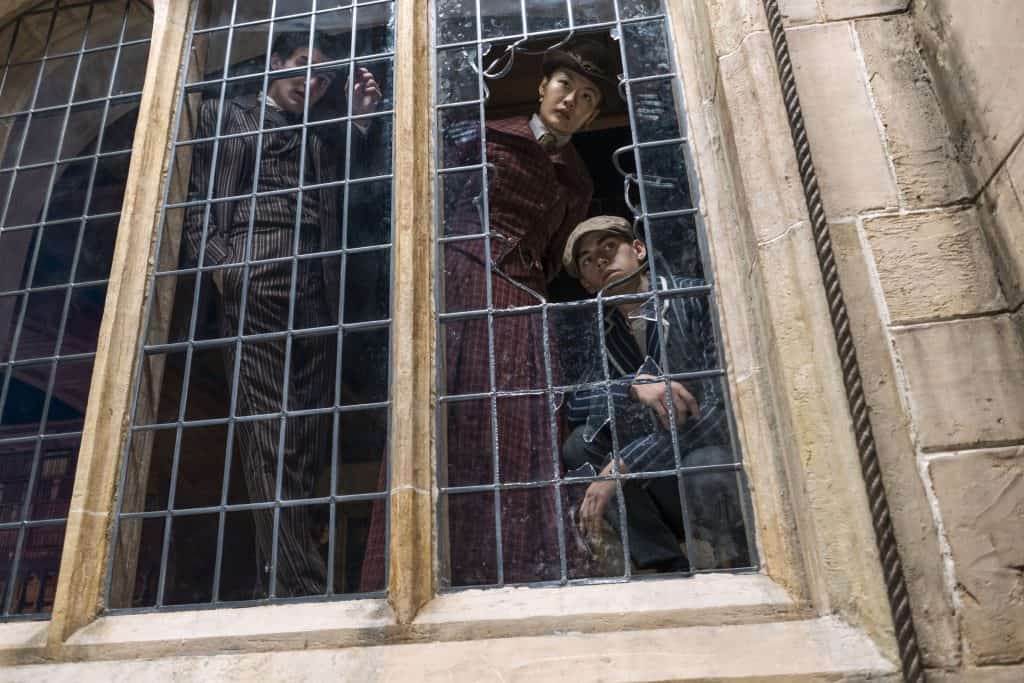
Young Sherlock is a beautiful series, and I want to be specific about what I mean by that. It is not beautiful in the way prestige television sometimes hides its vacuity behind expensive cinematography. It is beautiful in a purposeful, character-revealing way. Victorian Oxford breathes on screen — its cloistered quadrangles and candlelit interiors feeling simultaneously stifling and grand, the perfect environment for a young man who already finds any room too small for his mind.
The decision to film extensively on location — including sequences shot in Spain, standing in for the globe-trotting portions of the conspiracy — gives the series a physical scale that makes its ambitions feel earned rather than merely stated. When Young Sherlock claims to be a globe-trotting adventure, it actually goes somewhere. The production design, costumes, and cinematography work in total alignment to produce a world that feels consistent and lived-in, period-accurate without being museological.

Showrunner Matthew Parkhill’s scripts deserve particular attention. The architecture of the mystery — the layering of clues across eight episodes, the way character revelations and plot revelations are made to reinforce each other — reflects a writers’ room that planned meticulously before writing a single line of dialogue. This is long-form storytelling done with genuine confidence: trusting that audiences will carry details from episode to episode, that patience will be rewarded, that the emotional payoffs will land harder for having been earned across hours rather than minutes.
The pace is relentless without being breathless. The series moves. It does not linger or over-explain. It expects its audience to keep up — and in doing so, it respects them.
Is it worth it?
Young Sherlock is the kind of series that reminds you what prestige television can be when ambition, craft, and genuine creative daring are all pulling in the same direction. It is not a safe show. It makes bold choices — in what it withholds, in who it foregrounds, in how it reconfigures relationships we thought we knew — and nearly every one of those choices pays off.
Is it perfect? Almost. There are moments in the middle episodes where the conspiracy’s sprawl occasionally outpaces the emotional grounding, and viewers who come expecting a gentler, more procedural take on Holmes may need an adjustment period. But these are the complaints of a viewer who cares deeply about what the show is doing — and what it is doing is extraordinary.
This is Sherlock Holmes as you have never quite experienced him: raw, daring, and achingly human. With a cast operating at the height of their powers, a creative team that has trusted its vision completely, and the unmistakable Ritchie-shaped energy running through every frame, Young Sherlock is not just one of the best things on streaming right now. It is one of the best things I have watched in a very long time. Prime Video has a genuine phenomenon on its hands — and I cannot wait for what comes next.
This review is based on advance screeners provided for press purposes; this access did not influence my opinion.