

Nintendo has rebuilt Ocarina of Time as a staged production rather than a reinvention, handing you the whole set where the 1998 game only let you watch from the wings. It is the best version of the most important 3D adventure ever made.
Remaking a game everyone already copied
The hardest game to remake is the one whose ideas have dissolved into everything around it. Lock-on targeting, a single context-sensitive action button, a camera that frames a fight for you: Ocarina of Time invented the grammar the whole medium has spoken for almost three decades, and that success creates a strange problem for anyone revisiting it. Change too much and you lose the source. Change too little and a modern player sees only the conventions it gave away, with none of the surprise of seeing them for the first time.
Nintendo’s answer, on Nintendo Switch 2, is to treat the original as a stage play that deserves a new production rather than a new script. The dungeons are where they were. The story beats land in the same order. Kakariko’s windmill still turns, the Lost Woods still loop, and Ganondorf still rides past the drawbridge in the rain. What has changed is everything between you and that material: how Link moves, how the camera sees, how the world sounds, how much of it you are allowed to walk around in. Nintendo kindly provided a code for this review, and I took it to the end, through all of the dungeons, the side quests, the masks and the long walk up to Ganon’s Tower.
I came out convinced of something I had not expected to believe. A remake that refuses to reinvent its source can still be the braver option, provided it understands exactly which parts of the original were design and which were limitation.
A boy, a fairy and seven lost years
The premise is unchanged and needs little introduction. Link is the only child in the Kokiri Forest without a fairy, until Navi arrives with a summons from the dying Great Deku Tree. That errand turns into a quest for three spiritual stones, a meeting with a young Princess Zelda in the castle garden, and a desperate attempt to keep the Triforce out of Ganondorf’s hands. It fails. Link draws the Master Sword in the Temple of Time, sleeps for seven years, and wakes as an adult in a Hyrule that has curdled in his absence.
That structural gamble remains the most affecting thing in the series. You learn a world as a child, its shopkeepers and dogs and festival music, and then you watch it taken from you. Castle Town’s market, bright and crowded in the first half, becomes a ruin of ReDeads in the second. The remake understands that this is the emotional engine of the whole game, and much of its work goes into making that first half warmer and fuller so that the loss lands harder.
I will keep this spoiler-light past the opening act, but anyone who knows the original knows the shape of the back half: the temples of the six sages, Sheik’s songs, a final climb through a collapsing tower. All of it is here, in sequence, and the late material holds up better than nostalgia might lead you to fear.

Movement on your terms, finally
Link can jump. That sentence would have read as a joke in 1998, when the game decided for you whenever a ledge was worth leaping from, and it is the single change that most transforms how the remake feels in the hands. There is now a dedicated jump button and a sprint, the automatic leap is gone, and the right stick gives you full control of the camera instead of nudging it back behind Link’s shoulder. Swimming is faster. Items scroll on a horizontal menu in the style of Breath of the Wild, and the D-pad takes shortcuts, which matters a great deal once your inventory holds the hookshot, the bow, three kinds of magic arrows and the Lens of Truth.
The pleasure is how little of this disturbs the original’s design. Z-targeting is intact and still the backbone of every fight. Stalfos still punish a careless swing, Lizalfos still circle in pairs, and an Iron Knuckle still demands patience rather than reflexes. The new freedom of movement occasionally lets you shortcut a platforming section the designers clearly built around fixed jumps, and I found myself caring very little. Making Link responsive is the point, and the dungeons were never really about whether you could make a jump.
Motion aiming for the slingshot and bow is available and very good, precise enough that I left it on for the entire adventure. The old habit of rolling everywhere to move faster has been neutralized by the sprint. And the camera, freed from the fixed angles of the original, makes places like Death Mountain Crater feel enormous in a way the 1998 hardware could only imply.
Dungeons that still teach you to think
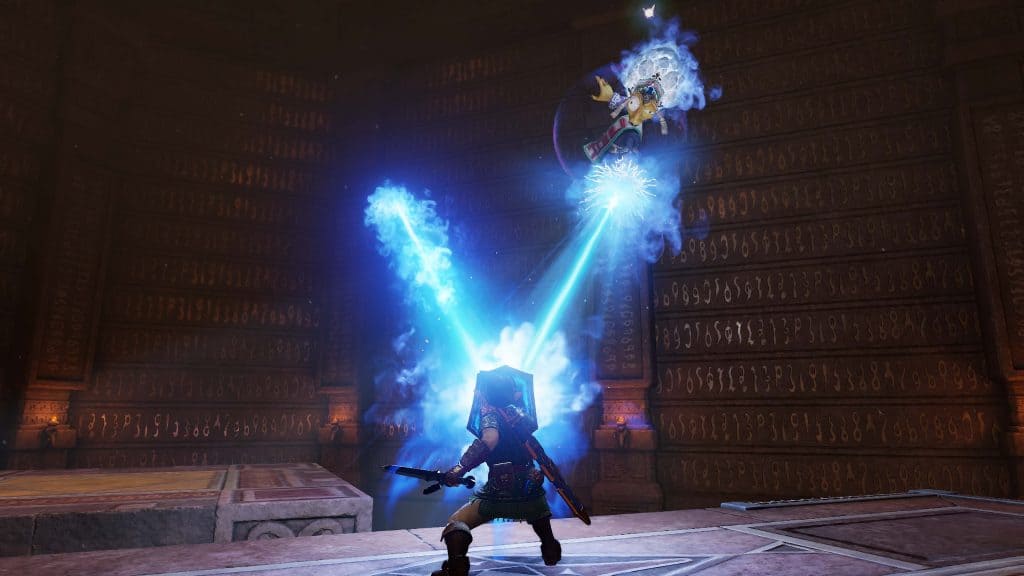
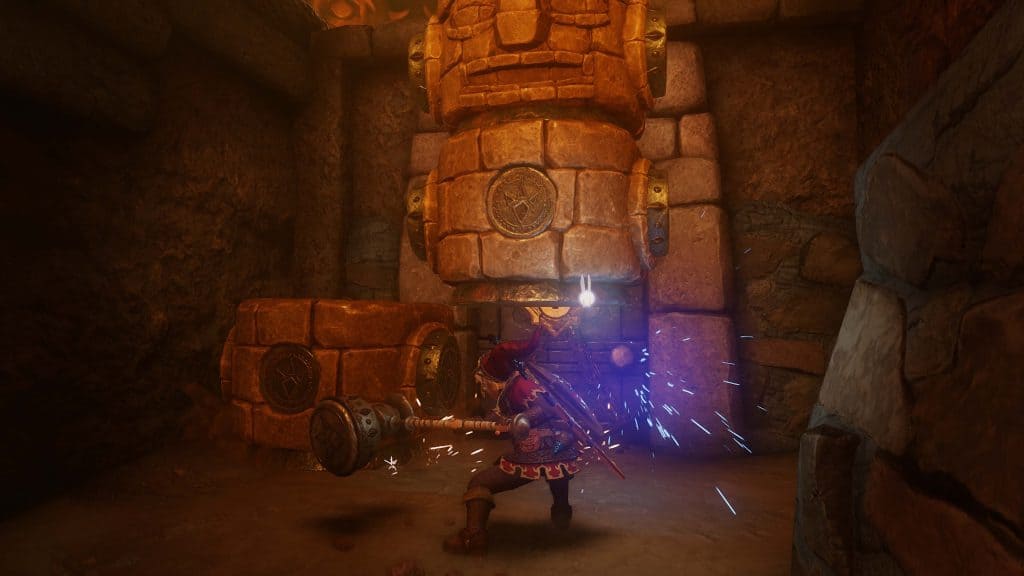
Nobody remakes Ocarina of Time for its combat. They remake it for the temples, and the temples remain the finest sustained run of dungeon design Nintendo has produced in 3D. The Forest Temple’s twisted corridors, the Shadow Temple’s invisible floors and the Spirit Temple’s handoff between child and adult Link are all exactly as clever as they were, and now far easier to read, because lighting and geometry finally communicate what the old textures had to leave to imagination.
The Water Temple, the dungeon that haunted a generation, has been smoothed rather than redesigned. The puzzle is the same puzzle, the same rising and falling water across the same central tower. What has gone is most of the friction that turned it into a meme, and without it the dungeon reveals itself as what it always was: an elegant vertical lock that rewards anyone willing to hold its layout in their head.
I will be honest about where the remake leans. It is easier than the original. Clues are more generous, the hint systems are friendlier, and seasoned players will rarely see the game over screen. The new Threads of Time log records what you have done and points toward what you should do next, which is a gift to anyone returning after a week away and a mild disappointment to anyone who liked being lost. You can strip the interface back to make things leaner, but there is no harder setting, and the game does not pretend otherwise.
That is a real trade, and I think it is the right one. Ocarina of Time is a game about discovery, and nothing about its difficulty was ever as important as its sense of place. A remake built to be someone’s first Zelda should not gate its best rooms behind the frustrations of 1998.

The story, now spoken
For the first time, Hyrule talks. Cutscenes are fully voiced and dialogue has been expanded across the cast, so Saria, Darunia, Ruto, Impa and the rest finally have voices to match the personalities their text boxes always suggested. Link remains silent, as he should, limited to effort sounds and the occasional startled breath.
The results are mostly a pleasure. Hearing the Great Deku Tree speak in that first cutscene resets your expectations of the whole adventure, and the late-game confrontations with Ganondorf benefit enormously from a performance with real weight. Some deliveries are stiff, particularly in the quieter exchanges, where Nintendo’s direction still occasionally sounds more careful than natural. It never sinks a scene, and most of the game’s conversation still plays out in text, which keeps the rhythm close to what the original intended.
The other quiet revolution is time itself. In 1998, the clock stopped whenever you entered a town, so Castle Town and Kakariko existed as separate day and night snapshots. Now the sun moves everywhere. You can stand in the market and watch the lamps come on, and characters appear and disappear on schedules that feel lived in rather than switched. It is a small change in systems terms and a large one in how real Hyrule feels.

A Hyrule carved for the stage
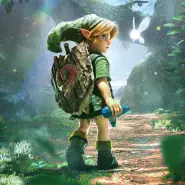
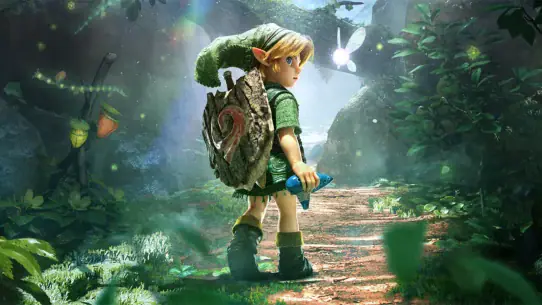
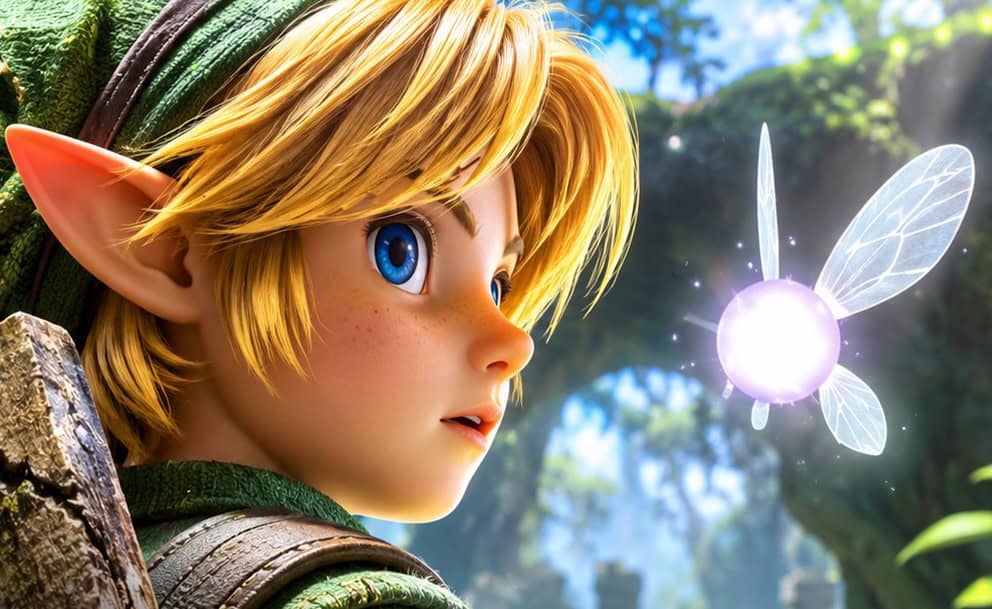
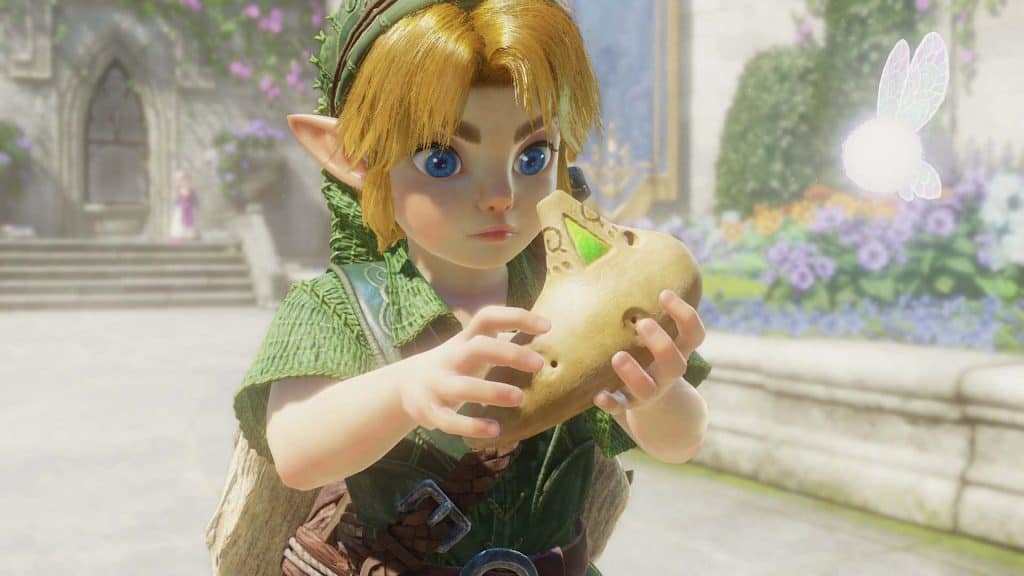
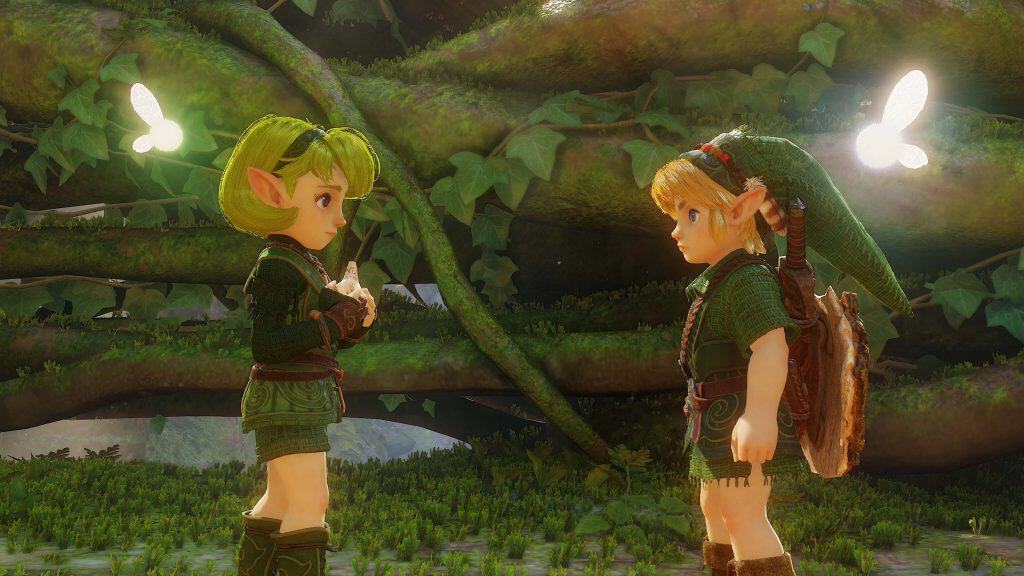
The look of this remake caused an uproar when it was revealed, and I understand why. The character models are not realistic and not cel-shaded. They are something stranger: faces with the slight stiffness and carved planes of puppets, as though Link and Zelda had been built in a workshop and lit for a performance. Nintendo has drawn on Japanese puppet theater for this style, and once you know that, the decision stops looking like a misstep and starts looking like a thesis.
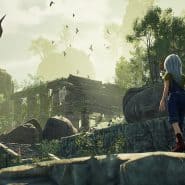
It suits the game. Ocarina of Time always had the air of a production, from the pre-rendered market backdrops to the fixed cameras framing each room like a proscenium. The remake leans into that sense of staging rather than fighting it. Characters move with an exaggerated, deliberate quality that reads clearly from across a room, and the environments behind them are the most detailed Nintendo has ever made, dense with foliage, masonry and weather. Rain leaves wet, reflective sheens on characters and stone, and the light across Hyrule Field at dusk does more to sell the passage of time than any line of dialogue.
The puppet faces still take a few hours to settle into, particularly young Link up close in cutscenes, and I suspect some players never will accept them. I came around fully. By the time the adult half of the game began, the style had become inseparable from the world, and I could not imagine this Hyrule rendered any other way.
The most striking single change is Castle Town. What was once a cramped, pre-rendered screen with a fixed camera is now a fully explorable district with interiors to enter, alleys to wander and crowds that move with purpose. It is the clearest expression of the remake’s philosophy: nothing has been added to the story, but the set has finally been built in three dimensions, and you are free to walk across it.
60fps, and what the image gives up for it
The technical priority is clear, and it is the correct one. Ocarina of Time on Switch 2 targets 60fps in both docked and handheld play and holds it with remarkable consistency, with only the occasional hitch tied to loading. That is three times the frame rate of the original Nintendo 64 release, which ran at 20fps, and double the 30fps target of the 2011 version on 3DS. In a game built around timing a shield against a Stalfos or lining up a hookshot across a chasm, that fluency changes everything.
Resolution is dynamic. Docked, the game moves between 1080p and 1440p, dipping toward the lower end in the busiest scenes. Handheld, it sits between 720p and 1080p. Nintendo has chosen AMD’s FSR 1 spatial upscaling with SMAA rather than the Switch 2’s DLSS hardware, and the trade shows in fine detail: some softness, and a shimmer along thin geometry and distant scenery that is more noticeable on the handheld screen. It is the one area where the remake looks less polished than its art direction deserves, and a cleaner reconstruction would have made the presentation close to flawless.
In practice, I stopped noticing within the first dungeon. Motion is smooth, the lighting is rich, and the art direction carries the image even when the edges soften. Loading screens have been deliberately retained in some areas to preserve the original’s rhythm between regions, a choice that will strike some as sentimental. They are short, and they rarely interrupt the flow between field and dungeon.

An orchestra in the pit
Koji Kondo’s melodies are among the most recognizable ever written for a game, and the remake re-records the entire score with a full symphonic orchestra. The Lost Woods theme, Gerudo Valley, the Temple of Time chant and Zelda’s Lullaby all return in arrangements that respect their shape while giving them room to breathe. Hyrule Field, which in 1998 shifted between short looping phrases, now swells and recedes like real film scoring, and the boss themes carry a weight the original synthesizers could only hint at.
The ocarina itself gets the remake’s most charming addition. You can play songs with buttons as before, or hum them into the Switch 2’s microphone, or play them on a real instrument held up to the console, and the game recognizes the melody. It is a gimmick in the strict sense, but a lovely one, and it fits a game whose central object is a musical instrument. Humming the Song of Storms at a windmill felt like a small piece of theater in its own right.
The orchestra also changes how the dungeons feel. The Shadow Temple and the Bottom of the Well were always the game’s horror chapters, and real strings and percussion give their dread a texture the original’s samples could only sketch. Play them with headphones.

Saves, secrets and the missing Master Quest
There is a lot to do beyond the main path. Gold Skulltulas, heart pieces, the trading sequence toward the Biggoron Sword, the mask quest, fishing, the horseback archery range at Gerudo Fortress and the haunting Poe-collecting in the field are all here, and the improved movement makes chasing them a pleasure rather than a chore. Threads of Time and the Zelda Notes support in the Nintendo Switch App, added through the version 1.1.1 update, make tracking collectibles far less of a notebook exercise.
There are caveats worth stating plainly. The remake allows a single manual save alongside several autosaves, which means starting a fresh run without losing your main file requires a second user profile on the console. That is a needless restriction in a game players love to replay. The bigger absence is Master Quest, the remixed second set of dungeons that shipped on GameCube and returned as a bonus mode in the 3DS version. Its omission leaves veterans without the harder, rearranged challenge they have come to expect from each new release of this game, and I hope Nintendo adds it later.
Young Link and Young Zelda amiibo are due in 2027, giving access to special masks in the game. That will add a little more to an already generous package, but nothing essential is held back.
None of this diminishes what is here. These are absences at the margins of a remake that gets the center exactly right.
Verdict
The Legend of Zelda: Ocarina of Time on Switch 2 is a restoration with the courage to leave a masterpiece’s design alone and the intelligence to change everything around it. Link finally moves the way your thumbs expect, Hyrule is built in full where it used to be painted, the score has an orchestra behind it, and the temples remain as brilliant as anything Nintendo has designed. The puppet-theater look will divide people for a while. It is also the most coherent and characterful art direction Nintendo could have chosen for a game that always felt like a staged play.
The caveats are real and small: an easier adventure, a single save slot, a soft image in handheld mode and no Master Quest. They do not touch the reason this game matters, which is that a boy grows up, the world he loved is taken from him, and he has to earn it back one temple at a time. That story has never been told better.
Play it if you have never played Ocarina of Time, because this is now the version to start with. Play it again if you have, because you will find the game you remember, and then discover it was always better than that.